Subsystem Investment Opportunity

Fund the first validation steps, not an entire space program.

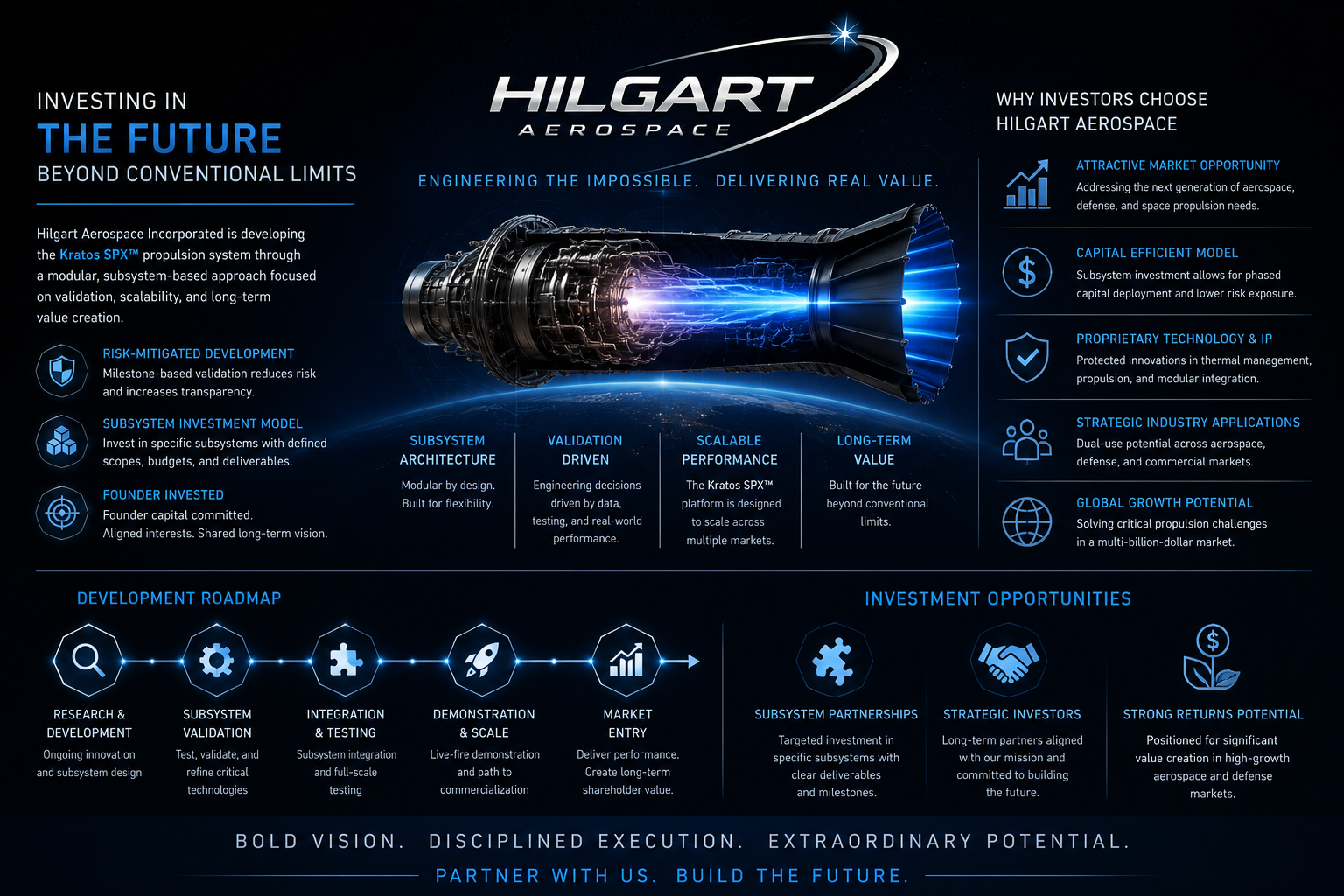
Hilgart Aerospace Incorporated is pursuing a disciplined subsystem-first investment strategy for the Kratos SPX architecture. The near-term focus is not broad speculative expansion. It is milestone-funded engineering, technical review, and validation of critical propulsion subsystems.

SAFE Investment Structure Subsystem Validation Thermal Management First $300K–$1M Per Subsystem Range
Current FocusThermal management validation and thermal-power equilibrium modeling.
Capital PathSubsystem rounds designed around specific deliverables and measurable progress.
Investment FormSAFE agreements may be used for early investment participation.
Development RangeEach subsystem may require approximately $300,000 to $1,000,000 from design through validation.

Investment Thesis: Subsystem Validation First

Hilgart Aerospace is developing the Kratos SPX as a modular propulsion architecture. The company’s investment thesis is focused on funding individual subsystems through design, analysis, technical review, prototype planning, and validation rather than attempting to fund full system development in one step.

This approach allows investors to participate in targeted engineering milestones with clearer deliverables, reduced scope ambiguity, and a more disciplined path from concept architecture to validated technology.

Defined MilestonesTechnical Risk ReductionIndependent ReviewValidation-Driven Development

Why Subsystems?

The SPX architecture is designed around removable, replaceable, testable, and independently validated subsystems. This helps isolate failure modes, reduce maintenance complexity, and support design evolution without requiring complete module redesign.

Why Thermal Management First?

Thermal management is the foundation of higher-energy propulsion operation. The first validation priority is the balance between power input, waste heat generation, coolant transport, heat rejection, material limits, and auxiliary power recovery.

SAFE Investment Approach

Hilgart Aerospace may use a Simple Agreement for Future Equity, commonly known as a SAFE, for early-stage investment participation. A SAFE allows qualified investors to provide capital now, with the investment converting into equity during a future priced financing round according to the agreed SAFE terms.

This structure may be appropriate for smaller angel investments and early subsystem funding because it avoids prematurely forcing a final company valuation while still documenting the investor’s future equity rights.

Future Equity ConversionNo Automatic Board SeatFounder Control PreservedAttorney-Reviewed Documents

What SAFE Investors Receive

  • A signed investment agreement documenting the investment amount and conversion framework
  • Future equity conversion rights under the agreed SAFE terms
  • Periodic company and milestone updates
  • Participation in the company’s early validation-stage growth

What SAFE Investors Do Not Receive Automatically

  • No automatic board seat
  • No officer role or management authority
  • No operational control of engineering decisions
  • No guarantee of return, liquidity, or future financing

Important Investor Notice

Any investment in Hilgart Aerospace involves significant risk, including the possible loss of the entire investment. This page is an informational overview and is not a formal securities offering, prospectus, or investment recommendation. Prospective investors should review all offering documents, risk disclosures, and legal materials before making any investment decision.

Subsystem Funding Range

Based on current planning, each major SPX subsystem may require approximately $300,000 to $1,000,000 to move from design review through engineering refinement, prototype planning, technical validation, and independent review. Actual costs may vary based on material selection, test requirements, university or laboratory engagement, fabrication complexity, and validation scope.
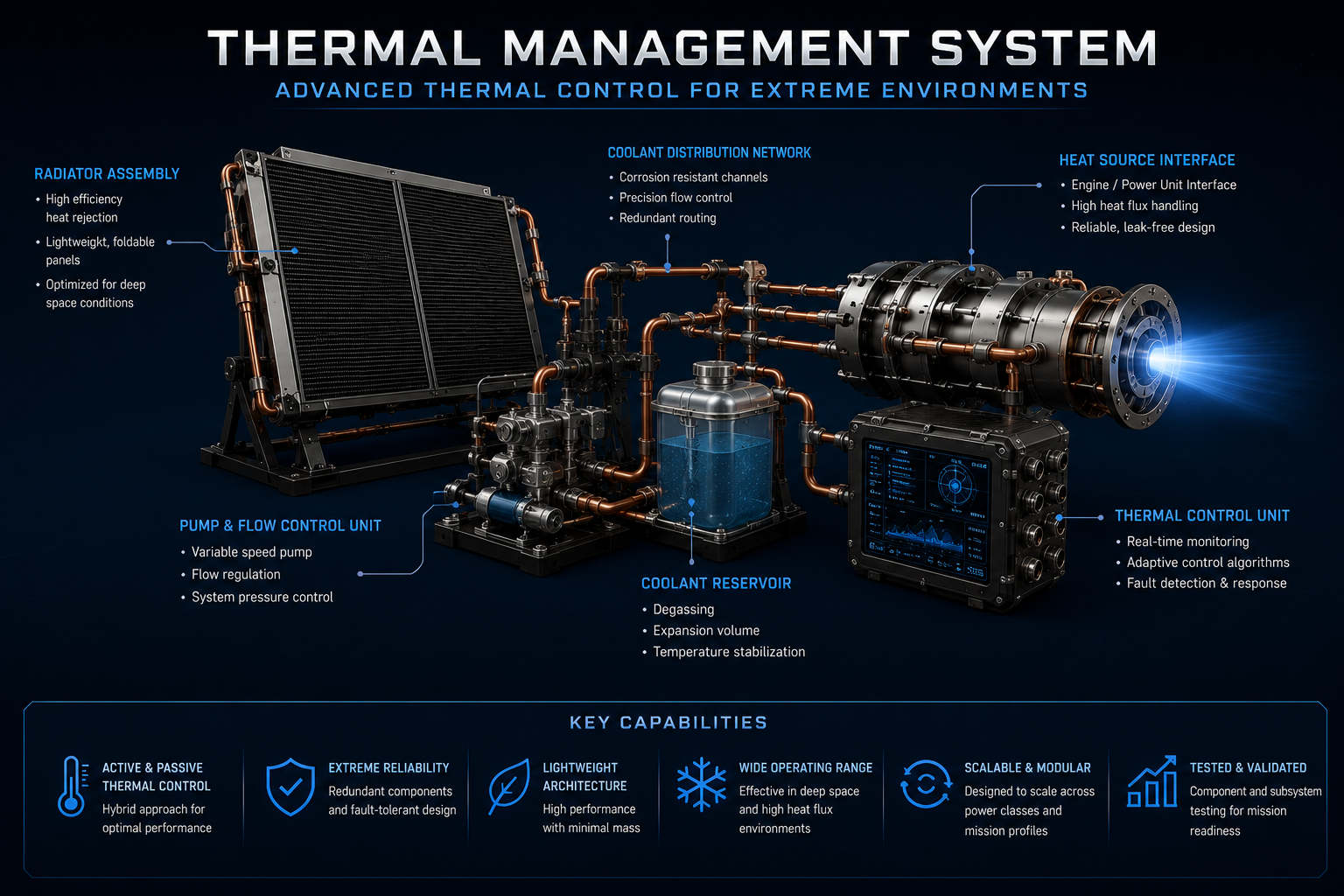
Thermal Management System

$300K–$1M

Thermal-power balance modeling, coolant trade study, materials review, radiator sizing, thermal spine analysis, and validation planning.
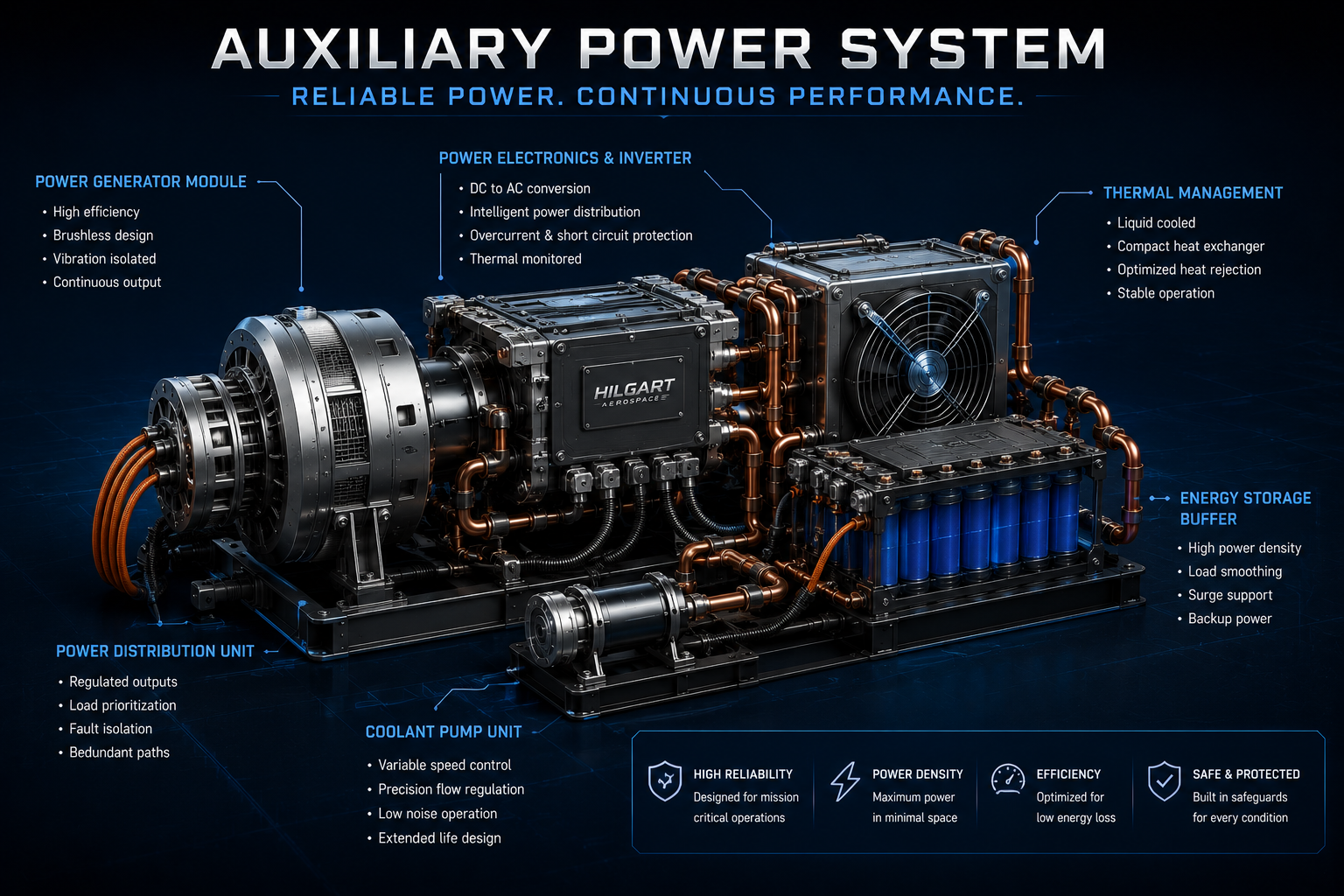
Thermal / Electric Auxiliary Power

$300K–$1M

Waste heat recovery analysis, Brayton-cycle integration studies, power routing, efficiency modeling, and subsystem interface definition.
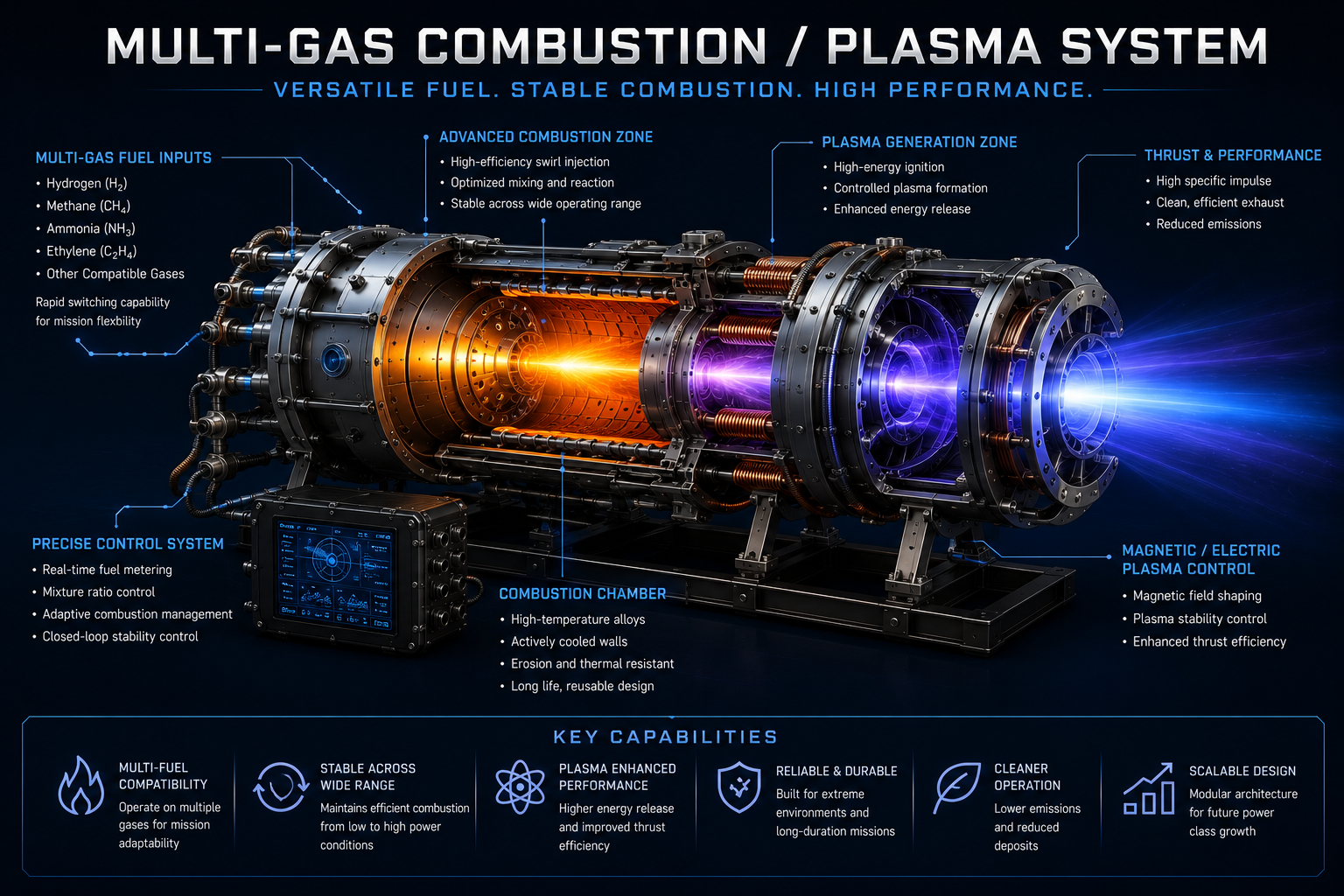
Multi-Gas Combustion / Plasma

$300K–$1M

Gas-ring design review, mixture control, flow balance, pressure stability, material exposure, and combustion-plasma validation planning.
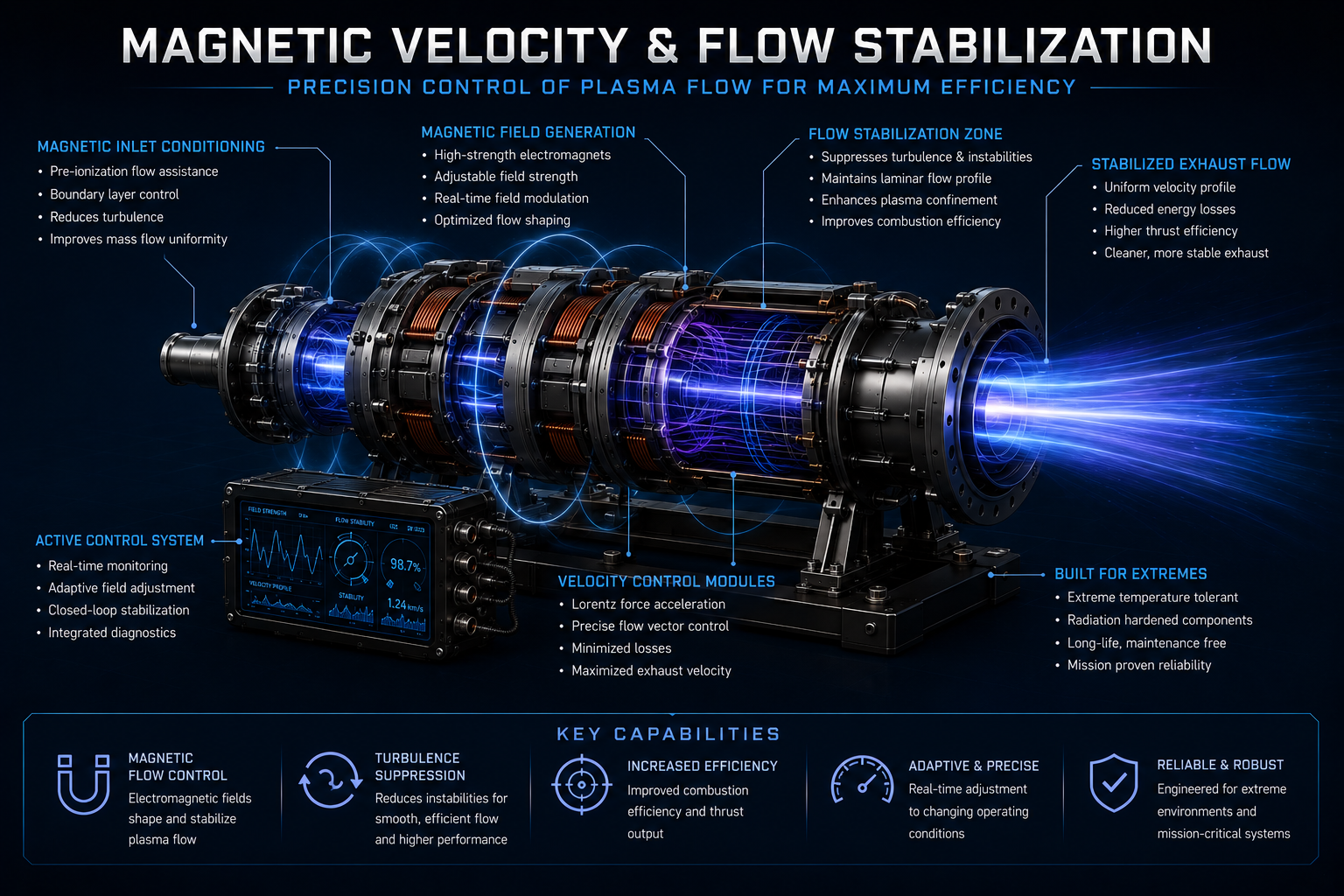
Magnetic Velocity & Flow Stabilization

$300K–$1M

Magnetic field architecture, propellant-flow stabilization, interface controls, thermal exposure effects, and performance modeling.
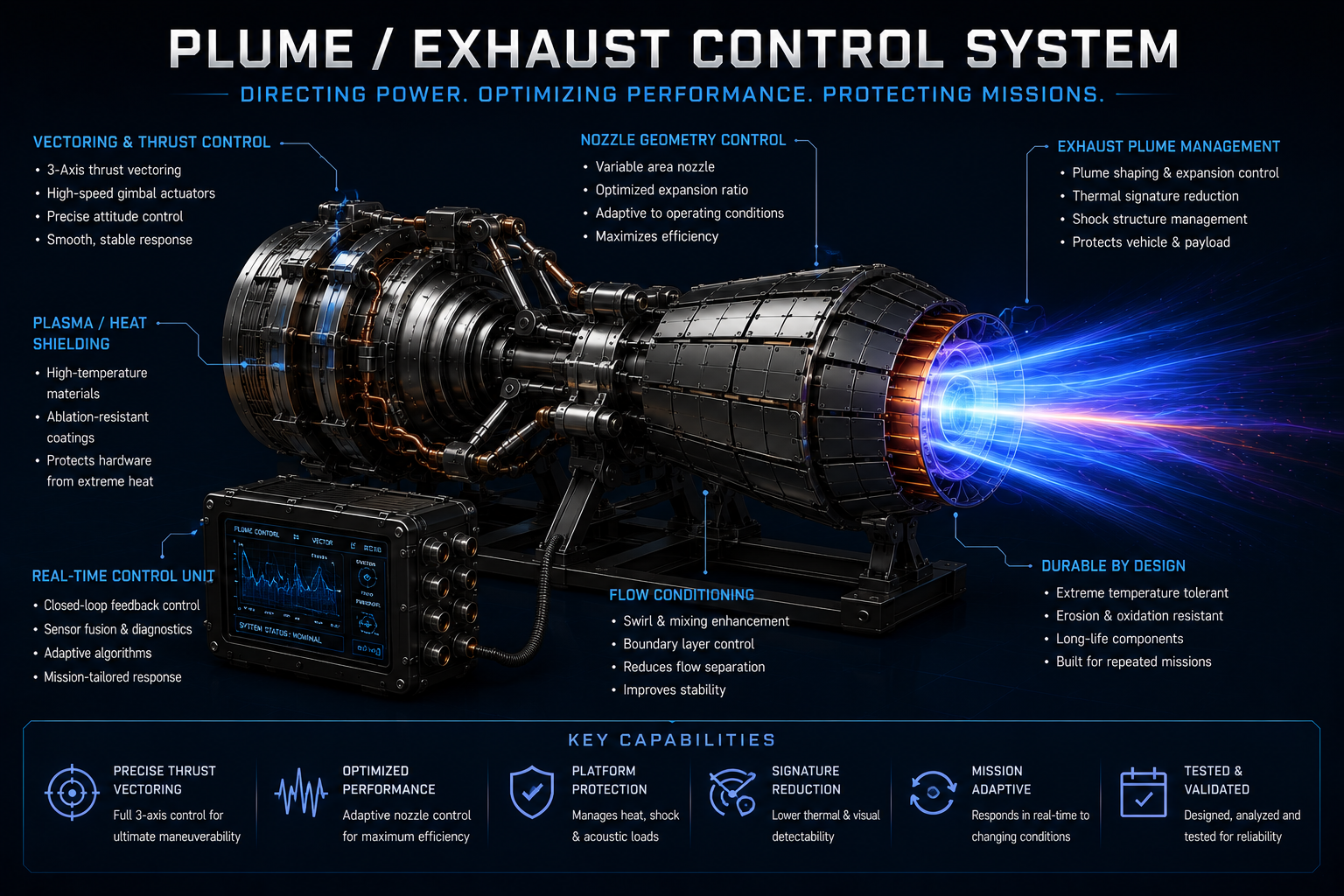
Plume / Exhaust Control System

$300K–$1M

Plume shaping, vector-control concepts, thermal and structural loading, exhaust stability, and subsystem validation requirements.
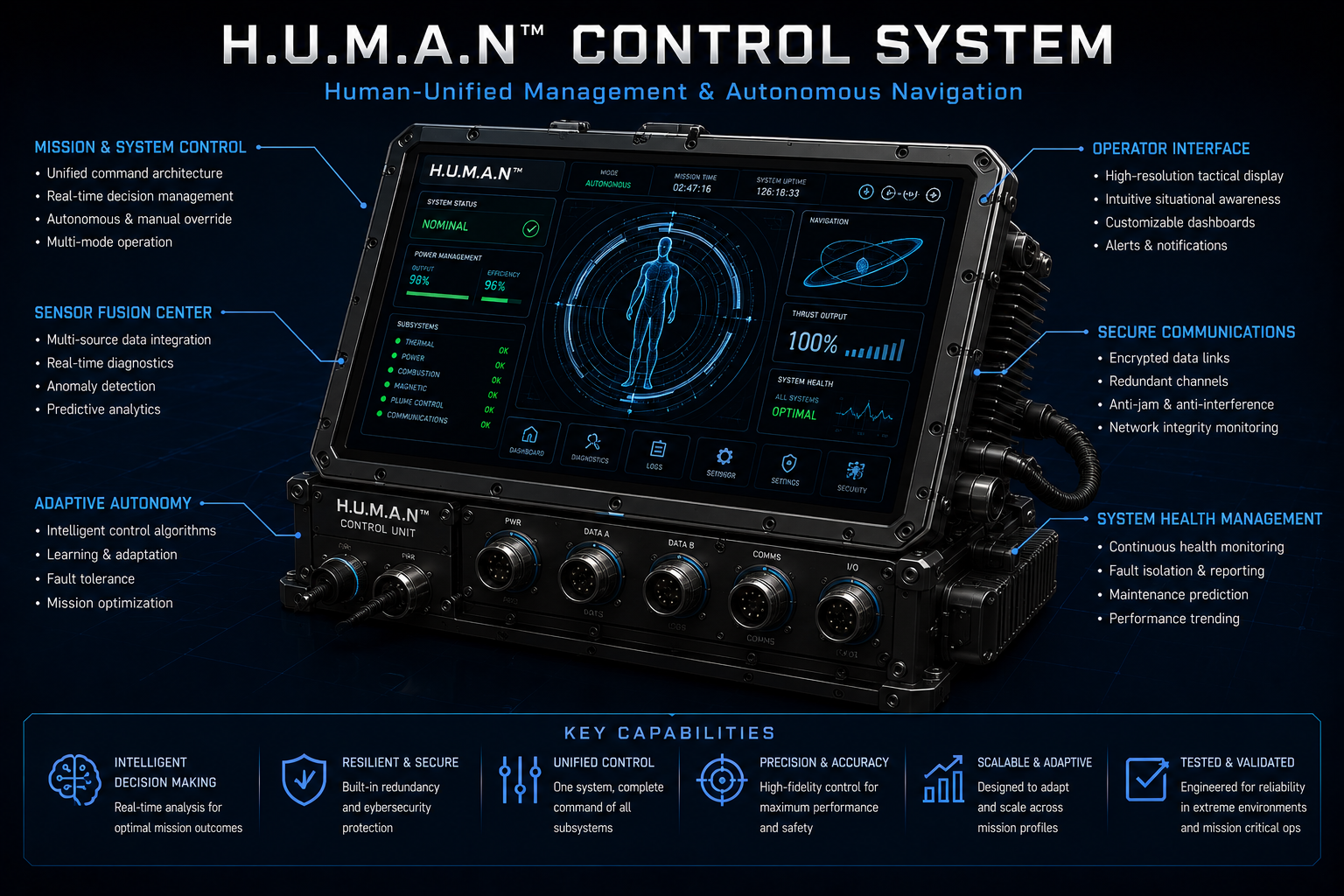
H.U.M.A.N™ AI Control System

$300K–$1M

Sensor integration, diagnostics, fault response, autonomous decision support, subsystem coordination, and control-logic validation.

Milestone-Based Capital Deployment

Subsystem investment is intended to be released and managed around defined milestones. The objective is to convert capital into engineering outputs, not general overhead.

MilestonePrimary WorkExpected Deliverable
Milestone 1Engineering review and assumption validationTechnical review package and risk notes
Milestone 2Modeling, trade studies, and subsystem interface reviewThermal-power model, coolant trade study, and interface recommendations
Milestone 3Detailed design refinement and manufacturing package preparationUpdated drawings, material selections, fabrication planning, and test plan
Milestone 4Prototype / test article planning and independent reviewValidation roadmap, independent review report, and next-stage funding plan

Hardware fabrication and full test execution may require additional capital depending on subsystem complexity and laboratory requirements.

Capitalization & Investor Participation

Hilgart Aerospace is founder-led and has been built with a staged capitalization approach intended to preserve founder alignment while creating room for outside investment, employee equity, advisors, and future financing rounds. SAFE investors generally do not receive immediate shares at the time of investment. Their investment converts into equity later according to the final SAFE terms.

Investor TypeTypical AmountLikely StructureGovernance Expectation
Friends / Family Supporter$5,000–$25,000SAFE or other attorney-approved instrumentNo board seat
Angel Investor$25,000–$100,000SAFE participationUpdates; no management rights
Lead Angel / Small Syndicate$100,000–$250,000+SAFE or negotiated round participationPossible advisory involvement; no automatic board seat
Institutional / Strategic Investor$500,000+Negotiated financing structureBoard observer or board discussion may be considered

Final investment minimums, valuation cap, discount rate, conversion terms, investor qualifications, and securities compliance procedures must be confirmed through legal counsel and formal offering documents.

Use of Capital

Investment capital is intended to support focused subsystem development and validation. The company’s priority is to fund engineering outputs that improve credibility, reduce technical uncertainty, and prepare the SPX architecture for future strategic, academic, and investor engagement.

  • Thermal-power balance modeling and engineering assumption review
  • Coolant media trade studies and materials compatibility analysis
  • Subsystem interface control documentation and design refinement
  • University, laboratory, and independent technical review engagement
  • Manufacturing drawings, dimensional plans, and prototype test planning
  • Intellectual property expansion and supporting technical disclosures
  • Investor documentation, data room materials, and milestone reporting

Founder Investment

Hilgart Aerospace has been founder-funded through early formation, engineering development, intellectual property preparation, digital infrastructure, legal setup, and investor-facing materials. This early founder investment demonstrates commitment prior to outside capital.

Funding Pathways

The company is pursuing a blended funding strategy that may include individual angels, investment syndicates, university research partnerships, SBIR/STTR-style funding, strategic partners, and future institutional financing.

Request the Investor Presentation

Hilgart Aerospace is currently refining its investor materials around subsystem investment, thermal management validation, SAFE participation, and milestone-based capital deployment. Qualified investors and strategic partners may request the current investor presentation for review.